
Key Takeaway & Executive Summary
Soccer Corner Kick Rules: Official tactical and regulatory breakdown delivering IFAB Laws of the Game analysis, VAR protocol insights, and practical on-field decision-making guidance.
Soccer Corner Kick Rules: How, When, And What Happens
The 2018 FIFA World Cup saw 17 goals scored directly from corner kicks—a reminder that one simple set piece can change the game’s momentum. Cristiano Ronaldo once said, “You need to be clever at corners—one second can create a goal or lose the match.” For fans, players, and coaches, understanding corner kick rules is crucial. Whether you play in a park or watch the Champions League, corners shape matches, create drama, and demand tactical mastery.
The beauty of a corner kick is its unpredictability. One moment, the ball is sitting quietly in the arc; the next, it’s flying through the air, surrounded by leaping defenders and attackers. Corners force every player to focus, from the goalkeeper to the striker lurking at the far post.
The pressure is intense—there’s no “easy” corner, and a single lapse in concentration can mean a goal. For beginners and experts alike, learning the details and tactics behind corners is essential to understanding why these moments matter so much.
Why Corner Kicks Matter: Stats And Impact
Corner kicks are not just routine restarts—they’re strategic opportunities. According to Opta, teams in top leagues average about 5–7 corners per game. In the Premier League, roughly 2% of corners result in a goal, making them more valuable than most free kicks. For context, Liverpool scored 12 goals from corners in the 2022-23 season, second only to Manchester City.
Corners often shift momentum. A well-placed corner can break a deadlock. Conversely, poor execution risks fast counter-attacks. Coaches invest hours in drills, and players study rival patterns. The pain: teams often waste corners, failing to convert chances. The reward: one precise delivery can change everything.
But why do corners matter so much? It’s not just about goals. Corners test a team’s organization, both in attack and defense. For example, a team struggling to create chances in open play can use corners to put pressure on the opponent.
Players who specialize in set pieces, like James Ward-Prowse or Toni Kroos, are highly valued because their deliveries can regularly create chaos and scoring chances. Even at amateur level, a well-rehearsed corner routine can surprise the other team, leading to shots on goal or rebounds.
Another hidden impact: corners can wear down defenders over time. Constantly defending corners forces players to stay alert and physically ready, which can create mistakes late in matches. That’s why some coaches deliberately push for corners to keep the pressure high, especially in the final minutes.
The Basics: What Is A Corner Kick?
A corner kick is awarded when the ball crosses the goal line (not the net) after last being touched by a defending player, and no goal is scored. The attacking team kicks the ball from the corner arc nearest where the ball went out.
Key rules:
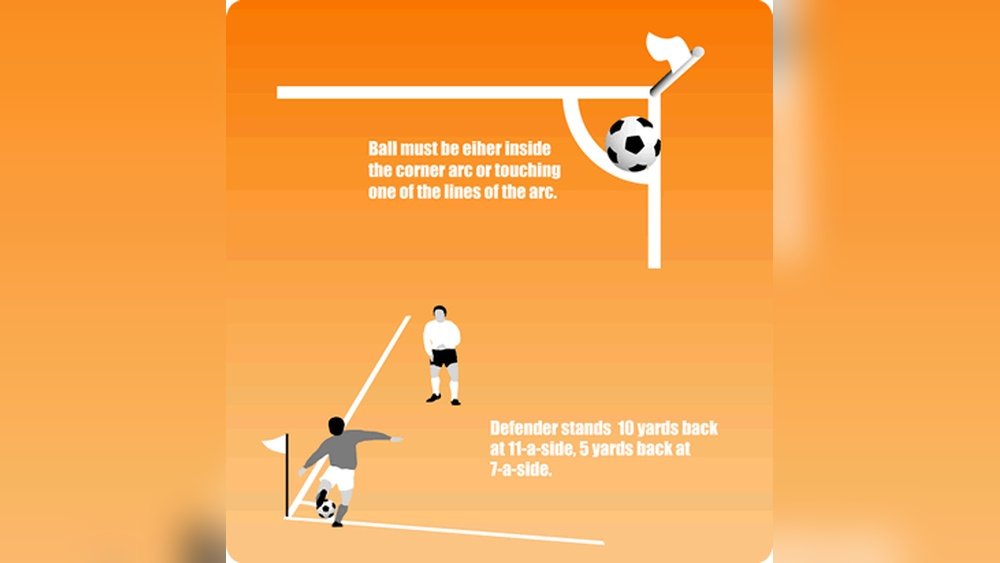
- Ball is placed in the corner arc (a quarter-circle, radius 1 yard)
- All opposing players must stay at least 10 yards away until the ball is kicked
- The kicker can’t touch the ball again until another player does
Corners happen frequently, but confusion often arises about who gets the kick and where it’s taken. This section is the foundation—master it before moving deeper.
It’s important to note that the corner arc is marked clearly on every soccer field, and the ball must be touching or inside the line—never outside. Players often try to sneak a few extra inches outside the arc for a better angle, but referees usually catch this and force a retake.
This small detail is crucial at higher levels, where even a tiny advantage can matter.
Also, the corner flag cannot be removed or moved to make more space. Some players think they can bend the flag, but that’s not allowed. The flag must remain in place at all times during the kick.
How Corner Kicks Are Awarded: Step-by-step
Understanding the awarding process helps players avoid mistakes and arguments. Here’s how corners are decided:
- Ball crosses the goal line (outside the posts): If a defender last touches the ball, it’s a corner. If an attacker, it’s a goal kick.
- No goal scored: If the ball enters the net from a defender’s touch, it counts as an own goal—not a corner.
- Referee signals the corner: He/she points at the corner arc.
- Ball placement: Attacking team places the ball inside the arc nearest the exit point.
Sometimes, the decision is not clear, especially if several players touch the ball quickly near the line. In these cases, the referee and assistants must decide who touched it last. Disputes often happen, but the referee’s call is final—even if video replays later show a mistake.
Common Mistakes
- Confusing throw-in and corner: If the ball leaves from the sideline, it’s a throw-in—not a corner.
- “Did the keeper touch?”: If unsure whether the goalkeeper touched the ball, the referee’s decision is final.
- Ball not fully inside the arc: The whole ball must be within or touching the arc line.
Another mistake is players rushing to take the corner before the referee is ready, especially if a substitution or injury just happened. Always check if the referee is watching before starting your run-up.
One beginner’s insight: Some players try to shield the ball out for a corner, but misjudge and let the attacker get the last touch. It’s a skill to know when to let the ball run and when to clear it for safety.
The Rules: What Happens During A Corner Kick
The rules for corner kicks are simple but strict. Breaking them can lead to retakes or fouls.
Do’s And Don’ts
| Do | Don’t |
|---|---|
| Place the ball within the corner arc | Kick the ball outside the arc |
| Wait for the referee’s whistle if needed | Take the kick before the referee signals |
| Ensure opponents are 10 yards away | Kick if opponents are too close |
| Use a legal kick (inside/outside foot) | Touch the ball twice in a row |
| Communicate with teammates | Block opponents illegally |
Key Rules To Remember
- The ball is in play once kicked and moves.
- The kicker cannot touch the ball again until another player touches it.
- Opponents must stay at least 10 yards from the arc until the ball is in play.
- If the ball goes directly into the net from the corner, it counts as a goal (rare but possible).
- Players can score directly from a corner (known as an Olympic goal).
One extra detail: If the wind is strong, the ball might move before being kicked. In this case, the kicker must wait and reset the ball. If the ball moves after being placed but before the kick, the referee will ask for the ball to be repositioned.
Also, if a teammate receives the ball from a short corner and is in an offside position, play continues—there is no offside from a direct corner. But once another teammate touches the ball, the normal offside rule applies.
When Corner Kicks Occur: Game Scenarios
Corners are awarded in specific situations. Here are common game scenarios:
- Defender blocks a shot: Ball goes out past the goal line, corner awarded.
- Goalkeeper saves but pushes ball out: Still a corner, unless it goes over the bar (then a corner).
- Defender misclears: Ball accidentally goes out—corner.
- Attacker shoots, defender deflects: Corner awarded.
Not awarded if:
- Attacker last touches ball: Goal kick instead.
- Ball crosses sideline: Throw-in.
Other examples include when a defender tries to clear a cross but misjudges and slices the ball past the post. Or, a goalkeeper tries to punch away a cross but the ball goes behind the goal line. Both of these lead to corners.
A less obvious scenario: If a defender shields the ball back to the goalkeeper, but the ball rolls out before the keeper touches it, the attacking team gets a corner. This is why defenders need to be careful with back-passes close to the goal line.
Tactical Corner Kick Types: How Teams Execute
Not all corners are equal. Teams use different styles to surprise opponents and maximize scoring chances.
Short Corner
A quick pass to a nearby teammate, instead of crossing into the box. Used to change angle, draw defenders out.
Example: Barcelona often uses short corners to create space for Messi or Alba to shoot from the edge.
Short corners can also be a way to keep possession and wait for a better crossing opportunity, especially if the defending team is strong in the air.
In-swinging And Out-swinging Corners
- In-swinging: Ball curves toward the goal. Right-footed kicker from left side, left-footed from right.
- Out-swinging: Ball curves away from the goal. Right-footed kicker from right side, left-footed from left.
Stat: Premier League teams score more from in-swingers, as defenders find it harder to clear balls coming toward the net.
The choice between in-swinger and out-swinger depends on your team’s aerial ability and the goalkeeper’s style. For example, if the keeper tends to punch rather than catch, in-swingers create more confusion.
Direct Corner (olympic Goal)
The kicker tries to score directly—rare, but memorable. Megan Rapinoe scored an Olympic goal in the 2012 Olympics.
This type of corner is often tried if the goalkeeper is out of position, or if the wind is strong in the kicker’s favor. It’s a risky move, but if executed well, it can catch everyone by surprise.
Far-post And Near-post Delivery
- Near-post: Ball is aimed at the post closest to the corner. Often used for flick-ons.
- Far-post: Ball is sent to the opposite post. Useful for tall attackers.
Some teams target the near post for quick flicks, hoping a teammate is running in behind defenders. Far-post deliveries are great for players strong in the air, or when the defense is slow to shift.
Quick Corner
Taken immediately after the ball goes out, before defenders set up. Only legal if opponents are 10 yards away.
Quick corners can create easy chances if defenders are not alert. It’s important for the attacking team to recognize these moments and act fast, but always check the referee is ready.
Pro Tips For Tactical Corners
- Use signals (hand gestures) to disguise your plan.
- Mix corner types to confuse defenders.
- Place tall players at the far post; agile players at the near post.
A non-obvious insight: Top teams sometimes use decoy runners—players who sprint away from the main target zone to pull defenders out, creating space for others. These details are planned in training, not left to chance.
How To Take An Effective Corner Kick: Step-by-step Guide
Great corners require skill, timing, and teamwork. Here’s how to maximize your chances:
1. Decide The Type
Choose based on team strengths and weaknesses. If your squad has tall players, aim for aerial duels.
Analyze the defense. Are they weak at the near post? Do they leave the edge of the box unguarded? Adjust your plan based on what you see.
2. Communicate
Signal teammates with pre-agreed gestures. Avoid telegraphing your plan to opponents.
Top teams have multiple routines for each match, using subtle signals to change plans at the last second if needed.
3. Ball Placement
Put the ball inside the arc. Use your foot to adjust for optimal angle.
The ball’s position can affect the spin and height of your cross. Try different placements during practice to learn what works best for your style.
4. Scanning
Check defender positions, goalkeeper stance, and teammate runs.
Look for mismatches—if your striker is being marked by a weaker defender, target that area. Also, watch for defenders who lose concentration.
5. Execution
Strike the ball cleanly. For in-swingers, use inside of your foot. For out-swingers, use outside.
Practice makes perfect. Some players use the wind to their advantage, bending the ball around defenders. A well-struck corner should be difficult to catch or clear.
6. Follow Up
Move after kicking—anticipate rebounds or second balls.
Don’t just stand still after the kick. Sometimes, the ball comes right back, creating a second chance. Teams that react fast to rebounds often score more.
Example: Trent Alexander-Arnold’s famous quick corner against Barcelona caught defenders off guard, leading to a goal.
A detail many players miss: Don’t always aim for the same spot. Varying your delivery keeps defenders guessing and increases your chances of success.
Advanced Corner Kick Tactics: Elite Team Insights
Top teams spend hours on set-piece routines. Here’s how pros use corners:
Screening And Blocking
Attackers set screens (like in basketball) to free up teammates.
For example, a player stands in the path of a defender, allowing a teammate to slip behind for a header. This is legal if there’s no pushing or holding.
Dummy Runs
Players pretend to make runs to distract defenders.
These movements force defenders to make decisions—follow the runner or stay in their zone. Well-coordinated dummy runs can create open space for a main target.
Overloading Zones
Teams crowd the far post or penalty spot, forcing defenders to make tough choices.
If defenders cluster at the near post, attackers can overload the far post for a late run. Some teams even start players outside the box, running in at the last moment.
Statistical Insights
- Liverpool scored 12 goals from corners in 2022-23, mainly using in-swinging deliveries.
- Teams with tall center-backs (like Real Madrid) win more aerial duels.
Non-obvious tip: The best teams rotate corner kick takers based on match-ups, not just footedness.
Another detail: Some teams use video analysis to spot defensive weaknesses in the opponent’s set-up, then target those zones specifically.
Defensive Corner Kick Strategies: How Teams Defend
Corner kicks are dangerous for defenders. Here’s how teams protect their goal:
Zonal Marking
Defenders guard areas rather than specific players. Effective against tall teams.
Each defender is responsible for an area; if the ball comes into their zone, they attack it. This strategy works best when defenders are disciplined and communicate well.
Man-to-man Marking
Each defender picks an attacker to mark. Useful for teams with physical defenders.
Man-to-man can prevent attackers from getting a free header but is risky if defenders lose their mark or are out-jumped.
Hybrid Marking
Combines both methods: some players guard zones, others mark key attackers.
This approach is popular at the highest level, as it covers both space and specific threats.
Pro tip: Always have a player on the posts for extra protection.
Another advanced tactic: Some teams leave a fast player near the halfway line during corners to threaten counter-attacks, forcing the attacking team to keep defenders back.
What Happens After A Corner Kick: Outcomes And Risks
Corners can produce several results:
- Goal scored
- Ball cleared
- Counter-attack launched
- Foul committed (often holding or pushing in the box)
- Second ball (rebound or loose ball)
Data Table: Corner Kick Outcomes
| Outcome | Percentage (Premier League 2022-23) |
|---|---|
| Goal Scored | 2% |
| Ball Cleared | 58% |
| Counter Attack | 10% |
| Foul/Offside | 5% |
| Second Ball Retained | 25% |
A critical tip: Many goals are scored not from the initial cross, but from second balls—loose balls after a clearance or a rebound. Teams must be alert to these moments, both in attack and defense.
Counter-attacks are a hidden danger. If too many attackers go forward, a quick clearance can leave the defending team exposed. Smart teams always leave one or two players back to guard against this risk.
Comparison: Corner Kick Vs Free Kick
Both set pieces offer scoring chances, but their dynamics differ.
| Factor | Corner Kick | Free Kick |
|---|---|---|
| Location | Corner arc | Anywhere on pitch |
| Opposition Distance | 10 yards | 10 yards (direct/indirect) |
| Scoring Chance | Medium | High (near goal) |
| Tactical Options | Many | Varied |
| Risk of Counter | High | Medium |
Takeaway: Corners often lead to quick counters if poorly executed. Free kicks near the box offer higher scoring chances.
A subtle difference: Free kicks allow for direct shots on goal from dangerous positions, while corners are almost always crossed. However, corners put more players in the box, so chaos is more likely.
Actionable Takeaways: Maximizing Corner Kick Success
- Practice delivery and timing: Most corners fail due to poor crosses.
- Use signals and routines: Mix up tactics to confuse defenders.
- Place tall players in key positions: Attack the far post.
- Monitor second balls: Many goals are scored from rebounds.
- Defend with zonal/man-to-man hybrid: Cover both areas and players.
Elite insight: The best teams analyze opponent corner defense using video and stats. Adjust your approach every match.
Another practical tip: Don’t rely on one player to take every corner. Switching kickers can change the angle and delivery, making it harder for defenders.
Beginners often overlook the importance of follow-up runs—always be ready for the ball to come back out or bounce in the box.
Pro Player Quotes And Insights
- “Corners are chess moves. One mistake, you lose.” — Sergio Ramos
- “We practice corners every day. Sometimes, it’s the difference between winning and losing.” — Virgil van Dijk
Many players say that set pieces, including corners, are often the difference in tight matches. That’s why elite teams dedicate significant training time to perfecting routines and adapting to each opponent.
Frequently Asked Questions
What Is The Minimum Distance Opponents Must Be From The Corner Arc?
Opposing players must be at least 10 yards away from the corner arc until the ball is in play. Referees enforce this rule strictly.
Can A Goal Be Scored Directly From A Corner Kick?
Yes, a player can score directly from a corner, known as an Olympic goal. It’s rare, but legal.
What Happens If The Kicker Touches The Ball Twice?
If the kicker touches the ball twice in a row (without another player touching it), the referee awards an indirect free kick to the defending team from the spot of the second touch.
How Do Teams Defend Against Dangerous Corners?
Teams use zonal marking, man-to-man marking, or a mix. Some place players on the posts for extra protection. Communication and anticipation are key.
Are There Any Famous Corner Kick Moments?
Yes, Trent Alexander-Arnold’s quick corner against Barcelona in 2019 is legendary. Megan Rapinoe’s Olympic goal in 2012 is another famous example. Check Wikipedia for more historic moments.


