
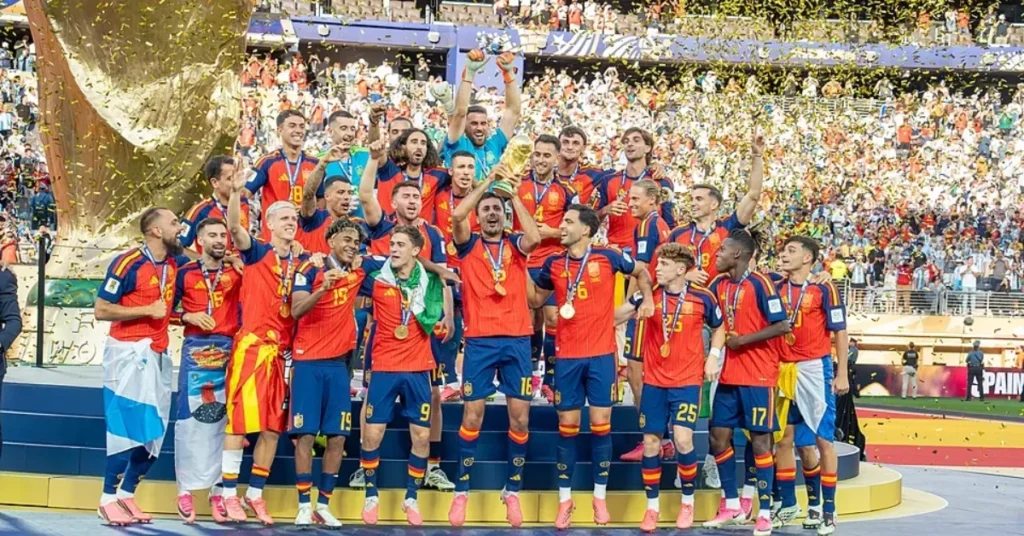
Inside a World Cup final where one team ran out of miracles — and the other ran into Emiliano Martínez.
There is a number from the 2026 World Cup final that reads like a typo.
Argentina — defending champions, scorers of nineteen goals in seven matches on the road to New Jersey — did not attempt a single shot in ninety minutes. Not one. They finished the night with two attempts, neither on target, and eight touches inside Spain’s penalty area across 120 minutes of football.
And Spain still needed until the 106th minute to beat them.
That gap, between total control and a scoreline that refused to move, is the real story of this final. Not the trophy. Not even Ferran Torres. The gap.
What actually happened
Spain beat Argentina 1-0 after extra time on Sunday, 19 July, at MetLife Stadium in East Rutherford, in front of a sell-out crowd of 80,663.
For most of the evening it looked as though it might never break. Spain kept the ball, worked the flanks, forced corner after corner, and kept finding Emiliano Martínez in the way of all of it. Ferran Torres, on just past the hour, met a Lamine Yamal cross with a header in the 66th minute — saved. Yamal, who had two of the best chances of the match, curled a free-kick toward the top corner — Martínez flew and got there. Dani Olmo was denied. Aymeric Laporte’s header was denied. Pau Cubarsí stung the goalkeeper’s palms from distance. By full time Martínez had made eleven saves, a record for a World Cup final.
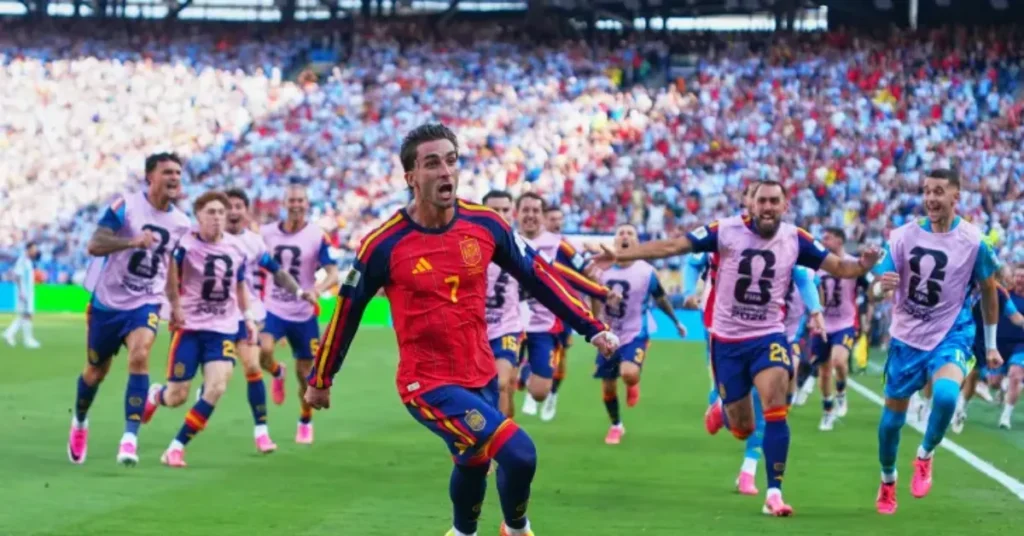
Argentina, meanwhile, reached half-time with no shots, no corners and no touches in the Spanish box.
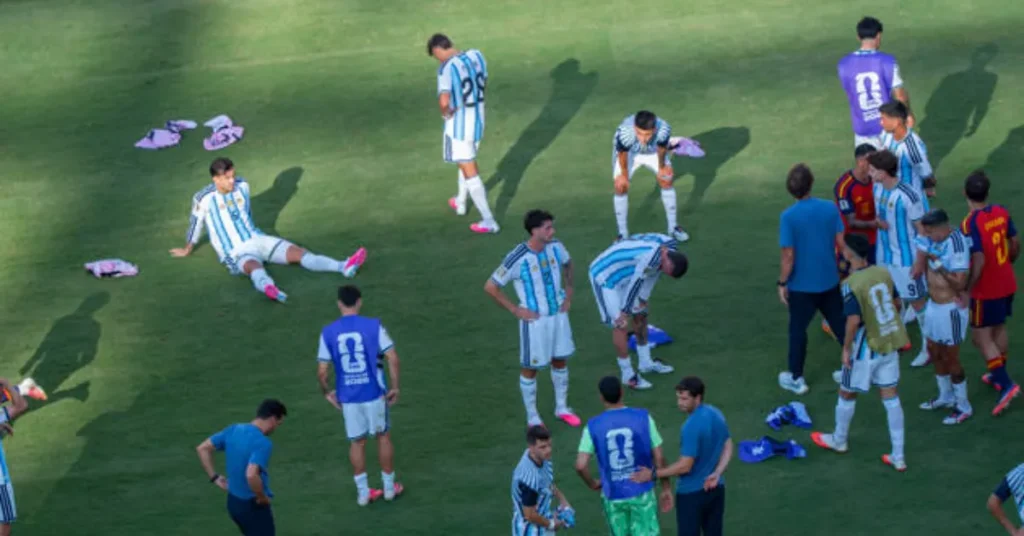
The match turned deep in second-half stoppage time. Enzo Fernández, already booked, brought down Cubarsí and was shown a second yellow by Slavko Vinčić in the 93rd minute. Argentina would spend the whole of extra time a man short.
Spain laid siege. Nico Williams, on since the 75th minute, turned the ball in from close range in the 96th, only for it to be struck off — Mikel Merino had fouled Nicolás Otamendi seconds earlier in the build-up. The first period of extra time ended goalless anyway.
Then, barely forty seconds into the second period, it gave. Yamal collected on the right and slipped the ball to Pedro Porro. Porro’s cross drifted deep, almost out past the far post, before Williams beat Nahuel Molina to the header and nodded it back across the six-yard box. Martínez had already committed. Torres, nine yards out, hit it first time with his left foot.
It was his first goal of the tournament, and the third of his World Cup career.
The number that tells the story
Spain finished with twenty shots and an expected goals total of 1.94. Argentina finished with two shots and an xG of 0.20.
Two attempts, in a World Cup final, from a side that had scored nineteen goals in seven games getting there.
That is not a bad night at the office. That is a team with nothing left.
Where it all went
Look at how Argentina arrived and the emptiness makes sense.
In the round of 32 they needed 120 minutes to see off Cape Verde, tournament debutants, twice pegged back before an own goal in the second period of extra time settled it 3-2. In the round of 16 they trailed Egypt 2-0 and scored three times in the final eleven minutes. In the quarter-final, a Switzerland side reduced to ten men in the 72nd minute still dragged them to extra time before Julián Álvarez and Lautaro Martínez got them out. And in the semi-final in Atlanta, Anthony Gordon put England ahead in the 55th minute and Argentina were still losing in the 85th, when Enzo Fernández curled one in from distance and Lautaro headed a Messi cross past Jordan Pickford in stoppage time.
Four knockout ties. Four escapes. Every one decided in the last ten minutes or beyond.
Lionel Scaloni’s side became the great survivors of this tournament, and survival is thrilling right up to the moment the bill arrives. They had played close to an extra match’s worth of football simply getting to New Jersey.
The weight was not only physical. Argentina were chasing back-to-back titles, something no nation has managed since Brazil in 1958 and 1962, and a fourth consecutive major honour after the Copa América in 2021, the World Cup in 2022 and the Copa América again in 2024. That is a great deal to carry into a final on legs that had already been asked for everything.
The cruellest detail: the man sent off before extra time was the same one whose goal had rescued them against England four days earlier.
Why the scoreline flatters Argentina
One goal in it, and it took 106 minutes. On the face of it, a tight final.
It was not a tight final. It was one of the most one-sided showpieces in the tournament’s history, and the only reason it stayed close was the man in the Argentina goal. Martínez’s eleven saves were not routine handling; several were the kind that decide tournaments. Spain generated 1.94 xG and scored once. Against an ordinary goalkeeping performance, this is 3-0 by the 70th minute and nobody is discussing red cards or disallowed goals at all.
Which is its own kind of tribute. Argentina’s most influential player on the night was their goalkeeper, and it wasn’t close.
The substitution that won a World Cup
Luis de la Fuente made two changes in the 62nd minute, one of them removing Mikel Oyarzabal — his leading scorer, the man who had converted the penalty that opened the scoring in the 2-0 semi-final win over France. At the time it looked, generously, brave.
Torres barely touched the ball for most of his time on the pitch. Then he touched it once, and the tournament was over. “I think at the end of the day, it was a goal scored by 47 million people,” he said afterwards.
That is a fair summary of Spain’s whole campaign. When the starters emptied out, the players coming on were still good enough to decide matches. Argentina, after four consecutive epics, no longer had that in reserve.
This was not a fluke
It is tempting to look at a 1-0 in extra time built on a red card, a disallowed goal and a substitute’s single touch and file it under fortune. The record book disagrees.
Spain conceded one goal in eight matches, to Belgium in the quarter-final — the fewest ever conceded by a World Cup winner. Unai Simón kept seven clean sheets, a record for a single tournament and two clear of the previous mark, and now has nine in his World Cup career, one short of the all-time record shared by Fabien Barthez and Peter Shilton. Earlier in the tournament he passed Walter Zenga’s 517-minute clean-sheet streak from Italia ’90.
They arrived unbeaten in 38 matches in normal time, the longest run in their history and a European record, having last lost to Colombia in a friendly in March 2024. They opened with a goalless draw against Cape Verde and then won seven straight: Saudi Arabia, Uruguay, Austria, Portugal, Belgium, France, Argentina.
De la Fuente became the oldest manager to win a World Cup. His record in charge of Spain now reads fourteen wins, one draw, one defeat. And with the women’s team’s title from 2023, Spain became the first nation to hold both World Cups simultaneously.
None of that happens by accident.
The show around it
This was also the largest audience football has ever drawn in the United States. The final was watched by 62.8 million viewers across Fox, Telemundo and Peacock — 38.9 million on Fox alone, the most-watched soccer telecast in American television history, peaking at 51.7 million in the quarter-hour Torres scored. Across the tournament Fox averaged 7.73 million per match over all 104 games.
The final also carried the first halftime show in World Cup history, curated by Chris Martin. Madonna opened alongside Ronaldo and Ronaldinho, followed by Justin Bieber, Shakira, BTS, Burna Boy, Gustavo Dudamel conducting “Seven Nation Army” with the Muppets, and the PS22 Chorus. The interval stretched to 27 minutes and 20 seconds. Donald Trump attended and presented the trophy alongside Gianni Infantino.
Across three host nations and 104 matches, nearly 6.9 million people came through the gates, an average above 65,000 a game. Whatever is eventually decided about the 48-team format, people turned up for it.
The end of Messi’s World Cup
At 39, this was almost certainly the last of it.
He finished with eight goals and four assists, second in the scoring charts and the recipient of the Silver Boot. He became the second player after Cafu to appear in three World Cup finals — 2014, 2022 and 2026 — and for the first time in twelve World Cup matches he neither scored nor assisted. He was in tears collecting his runner-up medal.
Two wins from three would have been a remarkable way to sign off. One from three is still a career nobody will touch. But it is hard not to wonder what a fresher Argentina might have done with the one afternoon that counted.
The awards
Rodri, Spain’s captain, won the Golden Ball, with Messi taking the Silver and Kylian Mbappé the Bronze.
Mbappé’s ten goals earned him the Golden Boot, making him the first player to win it twice, and his brace in England’s chaotic 6-4 third-place win over France carried his career World Cup tally to 22 — one past Messi, and the most in the competition’s history. Jude Bellingham’s seven took the Bronze Boot.
Pau Cubarsí, Spain’s 19-year-old centre-back, was named best young player ahead of teammate Lamine Yamal. Unai Simón took the Golden Glove. The Netherlands received the Fair Play award.
What it all means
Strip away the red card and the extra time and the story is straightforward. Spain were the better side across the whole tournament, not just the final. They defended like a team that refused to be opened up, and they had enough quality — on the pitch and on the bench — to eventually find the one moment they needed.
Argentina were brave in every knockout round and brilliant in patches, but they reached the final with the tank empty. Zero shots in ninety minutes is not misfortune. It is the honest accounting of a team that had spent everything just getting there.
If there is a lesson for anyone building toward 2030, it is that surviving four straight classics is not free. Something gives eventually, and for Argentina it gave on the biggest stage there is.
Spain have their second World Cup. Messi, in all likelihood, has played his last. And Ferran Torres, a 62nd-minute substitute who had been criticised all tournament, has one touch that will follow him for the rest of his life.