Key Takeaway & Executive Summary
How To Improve Speed: Built with heavy-duty weather-resistant frames and high-density knotless netting. Designed for rapid assembly, stable wind anchoring, and high-repetition shooting practice in backyards or club facilities.
Did you know the average professional soccer player covers over 10 kilometers per game, often sprinting at speeds above 30 km/h? But speed alone isn’t enough. The best players, like Kylian Mbappé and Heung-Min Son, combine explosive speed with quick, sharp changes in direction. This blend — speed and agility — can turn a regular player into a decisive performance advantage. Whether you’re aiming for school, club, or even pro level, learning how to improve speed and agility for soccer is vital.
Soccer is not just about being the fastest runner or having fancy footwork. It’s about making that speed count in short, game-changing moments. Think of a winger outrunning a defender to cross the ball, or a midfielder cutting sharply to intercept a pass.
These actions are the result of focused speed and agility training. If you want to stand out on the field, it’s not enough to be quick in a straight line—you must also be able to shift your speed, direction, and reactions in an instant.
Understanding Speed And Agility In Soccer
Speed in soccer means more than just running fast. It’s about accelerating quickly, sprinting past defenders, and reaching the ball first. Agility is the ability to change direction rapidly, dodge tackles, and react instantly to the play. Both are essential for every position, from wingers to goalkeepers.
Research shows that players with high agility are involved in 30% more scoring chances. For example, Lionel Messi’s low center of gravity and quick cuts let him beat defenders consistently, not just because he’s fast — but because he’s agile.
Many defenders, like Virgil van Dijk, use their agility to recover position quickly after an opponent’s move, while goalkeepers depend on both speed and agility to make last-second saves. Agility isn’t just physical—mental sharpness helps players read the game and react before others, turning quick feet into real advantages.
Even players who aren’t the absolute fastest can excel if they master these change-of-direction skills.
Standout Stat: In a study of elite youth soccer players, those with higher agility scores had 22% more successful dribbles and 19% fewer turnovers than less agile teammates.
Essential Components Of Speed And Agility
Improving these traits means working on several physical and mental factors:
- Explosive Power: Needed for sprints and jumps. This is built through exercises like jumps, bounds, and short bursts of high effort.
- Reaction Time: Quick decision-making during play. Reaction drills help you start faster and respond quicker to unpredictable moments.
- Balance and Coordination: Staying upright during rapid movements. Soccer requires you to keep control even when off-balance, like after a tackle or during a turn.
- Footwork: Precise steps and pivots. Good footwork means you can adjust your stride, step around defenders, or maintain possession under pressure.
- Flexibility: Reduces injury risk and aids movement. Flexible muscles and joints allow for a greater range of motion, making it easier to perform complex moves safely.
Let’s break down how to train each component.
To build explosive power, add exercises like squat jumps and medicine ball throws. For reaction time, use unpredictable cues—like a coach shouting directions or a ball bouncing randomly. Balance training can include standing on one leg while passing a ball, or using balance boards.
For footwork, practice moving in tight spaces, using both feet equally. And for flexibility, dynamic stretches before and static stretches after training help keep muscles healthy.
Practical Training Drills For Speed And Agility
Sprint Intervals
Sprint training is the foundation. Try this routine:
- Mark two points 30 meters apart.
- Sprint from point A to B, walk back, repeat 10 times.
- Rest 60 seconds between sprints.
This builds explosive acceleration.
Add variety: Try “flying sprints” where you gradually build up speed for 10 meters, then sprint for 20 meters at full pace. This mimics real game moments when you start fast, then push to top speed.
Ladder Drills
Agility ladders help with foot speed and coordination. Popular drills:
- One-Foot In Each: Step quickly through each box with one foot at a time.
- Lateral Shuffle: Move sideways, feet landing in each box.
Aim for 3 sets of 30 seconds per drill.
Increase difficulty by using “in-and-out” patterns (two feet in, two out) or combining forward and backward motions. Keep your arms moving naturally to stay balanced.
Cone Zig-zags
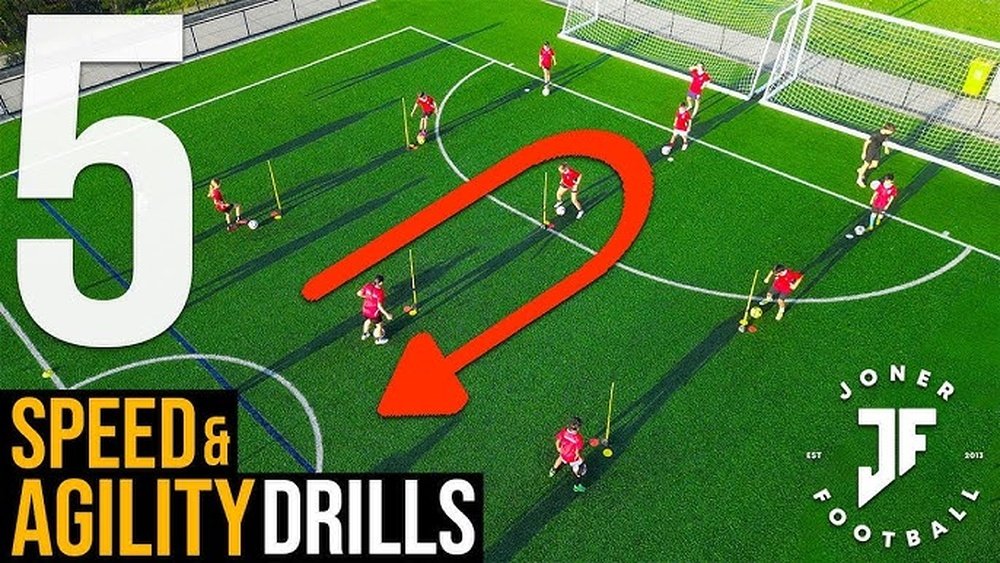
Set cones in a zig-zag pattern, spaced 2 meters apart. Sprint and cut sharply around each cone. Focus on:
- Planting your foot hard for direction change.
- Staying low for balance.
Do 4 zig-zag runs per session.
Challenge yourself by timing your runs, or using a ball to dribble through the cones. Try to keep your head up, scanning the “field” as you move.
Reaction Ball Catch
Use a small, uneven reaction ball. Have a partner drop it, and react quickly to catch it. This improves reaction time and hand-eye coordination.
If you’re training alone, bounce the reaction ball off a wall and try to catch it after the first bounce. This adds unpredictability, just like a deflected ball in a match.
Plyometric Jumps
Plyometrics build explosive power. Try:
- Box jumps: Jump onto a sturdy box, step down, repeat.
- Skater jumps: Leap side to side, landing on one foot.
3 sets of 10 reps each.
Be sure to land softly, bending your knees to absorb impact. This protects your joints and builds leg strength.
Comparison: Sprint Vs. Agility Drills
Here’s a direct comparison of how sprint and agility drills affect soccer performance:
| Drill Type | Main Benefit | Best For | Example Players |
|---|---|---|---|
| Sprint Intervals | Acceleration, Top Speed | Forwards, Wingers | Mbappé, Rashford |
| Ladder/Cones | Quick Direction Change | Midfielders, Defenders | Modrić, Walker |
| Plyometrics | Explosive Power | Goalkeepers, All positions | Alisson, Neuer |
Mixing both sprint and agility drills is crucial. Even defenders need bursts of speed, while attackers must change direction to lose a marker. Adapting your drills to your position and personal strengths makes your training more effective.
How Speed And Agility Affect Gameplay
A player with high speed can:
- Chase long balls and beat defenders.
- Recover defensively after losing possession.
- Create space for teammates by pulling defenders away.
A player with high agility can:
- Dribble through tight spaces.
- Dodge tackles and keep the ball.
- React quickly to sudden changes, like a loose ball or quick counterattack.
Teams that focus on these skills often have more counterattacks and higher goal-scoring rates. For example, Liverpool and Manchester City use fast, agile players to press and attack quickly.
In tight matches, a single burst of speed or sharp turn can create a scoring chance or prevent a goal. Coaches value players who combine both, as they can adapt to different situations throughout a game.
Real-life Examples: School, Club, And Family Soccer
School Level
Samir was always last in sprints at school soccer. After two months of ladder and cone drills, his sprint time improved by 0.8 seconds. He started outrunning defenders and scored 5 goals in 3 games.
Even more, Samir gained confidence. His coach noticed he was more willing to call for the ball, knowing he could reach it. This extra self-belief often translates into better overall performance.
Club Level
At a local club, Coach Laura introduced plyometric jumps and zig-zag cones. Within 6 weeks, the team’s average agility test score increased by 18%. Players were able to respond faster to tactical changes.
Not just that, injuries from awkward falls or off-balance turns dropped, as players’ stability improved. This shows that agility training also makes teams more resilient over a season.
Family Play
In backyard games, families can set up cones and ladders. Kids who practice regularly become noticeably faster and more agile, leading to more fun and competitive matches.
Parents can join in too, turning training into a bonding activity. Even short, playful drills help children develop a love for movement and sport.
Step-by-step Plan To Improve Speed And Agility
Here’s a weekly plan for real progress:
- Warm-up: 10 minutes of jogging and dynamic stretches.
- Sprint Intervals: 2 days per week.
- Agility Ladder/Cones: 3 days per week.
- Plyometric Jumps: 2 days per week.
- Cool-down: 10 minutes of light stretching.
Repeat for 6–8 weeks. Log your times and agility scores for motivation.
You can make a simple chart to record your sprint and zig-zag times each week. Seeing improvements, even small ones, keeps you motivated. If you hit a plateau, try new drills or ask a coach for tips.
Common Mistakes To Avoid
Improving speed and agility takes smart training. Avoid these errors:
- Skipping Warm-ups: Leads to injuries. A good warm-up prepares your muscles and joints.
- Doing Only Sprints: Ignores agility, making you fast but not nimble. Balance your routine.
- Poor Technique: Sloppy footwork reduces benefits. Focus on quality, not just speed.
- Not Resting Enough: Muscles need recovery. Overtraining can cause fatigue or injury.
Many beginners also forget to track their progress. Without measuring, it’s hard to know if you’re improving.
Another missed step: ignoring flexibility and balance. If you only train speed, you may become stiff or less coordinated, making injury more likely.
Recommendations By Use Case
Depending on your goals, adjust your training:
| Use Case | Recommended Focus | Session Frequency |
|---|---|---|
| School Soccer | Ladder drills, basic sprints | 3x per week |
| Club Level | Plyometrics, advanced agility | 4–5x per week |
| Family/Backyard | Fun cone games, short sprints | 2x per week |
For club or competitive players, mix drills every month to prevent adaptation. For beginners or family games, focus on fun and consistency instead of intensity.
Two Insights Beginners Often Miss
- Agility is more mental than physical: Quick decision-making during play is as important as fast feet. Reacting to opponents, anticipating moves, and staying focused all help agility. Try visualizing plays before training or using unpredictable drills to sharpen your mind and body together.
- Strength training boosts speed and agility: Building core and leg muscles improves both traits. Squats, lunges, and planks are simple ways to add strength training.
A strong core keeps you stable during turns, while strong legs help you push off faster and land safely. Don’t skip strength work—it’s the “hidden” base for speed and agility.
Data: Speed And Agility Test Results
Players often wonder how much improvement is possible. Here’s a sample data card showing real test results from a youth soccer camp:
Speed Test: Average 30m sprint time dropped from 5.4s to 4.7s after 6 weeks.
Agility Test: Zig-zag cone course time improved from 11.9s to 9.8s.
Improvements vary, but consistent training nearly always leads to better results. Keep your own records so you can celebrate your gains.
Practical Tips For Faster Results
- Always warm up before drills.
- Mix up your routine to prevent boredom.
- Train with a partner for motivation.
- Use a stopwatch to track times.
- Set realistic goals — aim for improvement, not perfection.
Add variety by changing the surface (grass, turf, gym) or doing drills with and without a ball. If you get bored, invent new patterns or challenge friends to mini-competitions.
Recovery And Injury Prevention
Training hard is good, but recovery is key. Stretch after every session, drink plenty of water, and sleep well. If you feel pain, stop and rest. Most injuries come from overtraining or ignoring small aches.
Listen to your body. If you’re tired or sore, take an extra rest day. Use foam rollers or massage balls to ease muscle tension. Remember, progress is faster when you avoid injury and stay consistent.
For more tips on injury prevention and soccer training, see this research on soccer fitness.
Frequently Asked Questions
How Often Should I Train Speed And Agility For Soccer?
For best results, aim for 3–4 sessions per week. Mix speed, agility, and plyometric drills. Rest between sessions for recovery.
What Is The Best Age To Start Speed And Agility Training?
Players can start as young as 7–8 years old. Begin with simple drills, focusing on fun and safety. Progress to harder drills as skills improve.
Can Speed And Agility Training Prevent Injuries?
Yes. Proper training strengthens muscles and improves balance, which helps prevent common soccer injuries like sprains and strains.
How Long Does It Take To See Improvement?
Most players notice progress after 4–6 weeks of regular training. Improvement depends on consistency, effort, and starting fitness.
What Equipment Do I Need For Speed And Agility Drills?
Basic equipment includes cones, agility ladders, a stopwatch, and a safe, flat surface. For plyometrics, a sturdy box is helpful.